
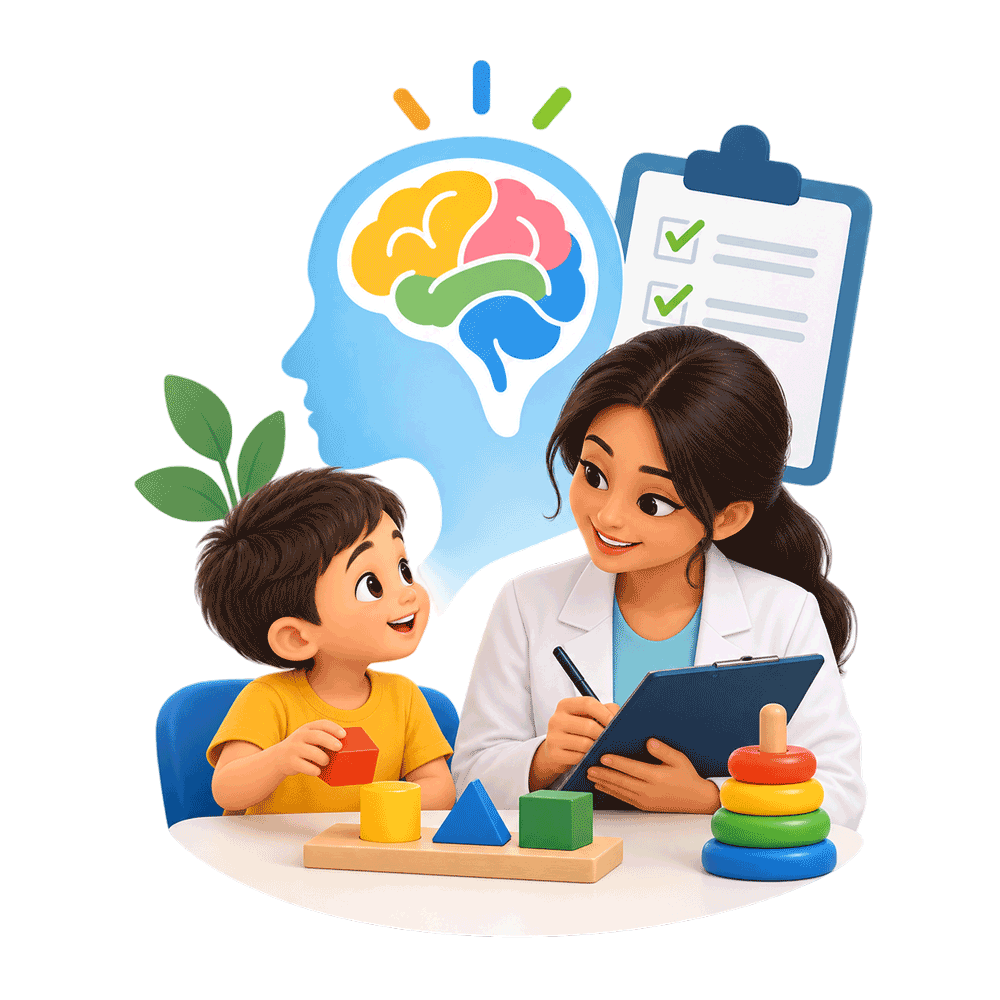
Psychological Evaluation
Every child develops, learns, communicates, and responds to the world in a different way. When parents notice concerns related to behaviour, emotions, attention, learning, communication, social interaction, or overall development, a psychological evaluation can help provide greater clarity.
At EVE Child Development Centre, psychological evaluation focuses on understanding a child’s strengths, challenges, developmental profile, behaviour, learning needs, and emotional well-being.
EVE CDC provides Psychological Evaluation in Kollam and Kochi, along with online parent consultations and follow-up guidance where appropriate, helping families access professional developmental support more easily.
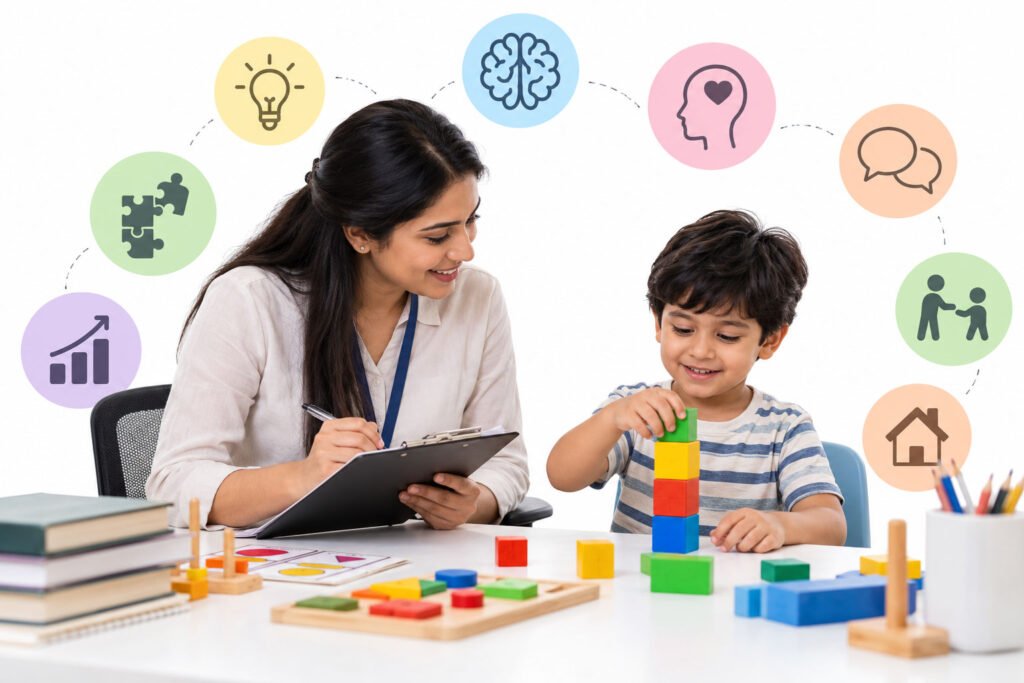
What Is a Psychological Evaluation?
A psychological evaluation is a structured process used to better understand a child’s developmental, behavioural, emotional, cognitive, learning, and social functioning.
It is not simply about giving a child a label.
The purpose of an evaluation is to understand:
- The child’s strengths
- Areas where the child may need additional support
- Developmental abilities
- Learning and attention skills
- Behavioural patterns
- Emotional functioning
- Social interaction
- Communication-related concerns
- Everyday functioning
Depending on the reason for referral, the psychologist may use interviews, observations, standardized assessment tools, questionnaires, and information from parents, teachers, or other professionals.
The findings can help guide appropriate therapy, educational support, parent strategies, or further assessment when needed.
When Should Parents Consider a Psychological Evaluation?
Parents may consider a psychological evaluation when they notice ongoing concerns related to their child’s development, learning, behaviour, emotions, or social functioning.
Some common reasons for seeking an evaluation include:
- Developmental delays
- Difficulty with attention or concentration
- Frequent behavioural challenges
- Emotional outbursts
- Difficulty managing frustration
- Learning difficulties
- Poor academic performance despite regular support
- Difficulty understanding or following instructions
- Social interaction challenges
- Communication concerns
- Difficulty adapting to changes
- School-related anxiety or avoidance
- Significant changes in behaviour
- Concerns related to autism
- Concerns related to ADHD
- Difficulty with memory or problem-solving
- Difficulty participating in age-appropriate activities
A professional evaluation can help parents better understand what may be contributing to these concerns and what support may be appropriate.
Psychological Evaluation Services at EVE CDC
At EVE Child Development Centre, psychological evaluation is planned according to the child’s age, developmental level, family concerns, and reason for referral.
The assessment process may look at different areas depending on the child’s individual needs.
Developmental Assessment
A developmental assessment helps understand how a child is progressing across different developmental areas.
This may include:
- Cognitive skills
- Communication
- Social interaction
- Motor development
- Daily living abilities
- Play skills
- Adaptive behaviour
Developmental assessments can be useful when parents or professionals have concerns that a child may not be reaching expected developmental milestones.
Cognitive Assessment
Cognitive assessment helps understand how a child processes information, solves problems, remembers information, and approaches different types of tasks.
Depending on the child’s age and needs, assessment may explore areas such as:
- Reasoning
- Memory
- Problem-solving
- Processing abilities
- Visual-spatial skills
- Attention
- Understanding of concepts
The results can help professionals better understand the child’s learning profile.
Learning and Academic Assessment
Some children experience persistent difficulties with reading, writing, spelling, mathematics, comprehension, or classroom learning.
A psychological evaluation may help identify areas of strength and difficulty related to learning.
Assessment may explore:
- Reading skills
- Writing abilities
- Mathematics
- Memory
- Attention
- Processing
- Academic performance
- Learning strategies
The findings may help guide special education or remedial support where appropriate.
Attention and Concentration Assessment
Children may sometimes find it difficult to:
- Stay focused
- Complete activities
- Follow instructions
- Organize tasks
- Wait for their turn
- Manage impulsive behaviour
- Maintain attention in the classroom
A psychological assessment can help understand whether attention-related difficulties are affecting the child’s everyday functioning and learning.
Evaluation may form one part of a broader assessment when ADHD or other developmental concerns are being considered.
Behavioural Assessment
Behaviour often provides important information about what a child may be experiencing.
A behavioural assessment may consider:
- Tantrums
- Aggression
- Frequent refusal
- Emotional outbursts
- Difficulty following rules
- Impulsive behaviour
- Repetitive behaviours
- Difficulty with transitions
- School behaviour
- Social interactions
The psychologist may discuss when these behaviours occur, how often they happen, possible triggers, and how they affect the child’s daily life.
Emotional and Social Assessment
Children may sometimes experience difficulties understanding or managing emotions.
A psychological evaluation may explore concerns such as:
- Anxiety
- Fear
- Low confidence
- Emotional regulation
- Withdrawal
- Difficulty interacting with peers
- Frequent sadness or irritability
- Difficulty coping with change
- School-related stress
The aim is to understand the child’s emotional and social functioning and identify areas where additional support may be helpful.
Autism-Related Evaluation
Some children may show differences in areas such as:
- Social communication
- Eye contact
- Interaction with others
- Play
- Repetitive behaviour
- Flexibility with routines
- Sensory responses
- Communication development
When autism-related concerns are present, a qualified professional may conduct or recommend a more detailed assessment using appropriate clinical methods.
The purpose of assessment is to better understand the child’s developmental profile and identify the support they may need.
ADHD-Related Evaluation
Parents or teachers may notice concerns such as:
- Difficulty maintaining attention
- Frequent distraction
- Impulsive behaviour
- Difficulty waiting
- Excessive activity
- Difficulty completing tasks
- Poor organization
- Difficulty following routines
A psychological evaluation can form part of the process of understanding these concerns.
Assessment typically considers the child’s functioning across different environments and may include parent and teacher information where appropriate.
School and Learning Concerns
Children spend a large part of their day in learning environments, so school-related difficulties can sometimes be an important reason for psychological assessment.
Parents may seek evaluation when a child:
- Avoids schoolwork
- Struggles with reading or writing
- Has difficulty understanding lessons
- Finds exams or tests challenging
- Has difficulty remembering information
- Is falling behind academically
- Finds classroom participation difficult
- Experiences significant school-related stress
Assessment findings can help guide educational planning, special education support, or other interventions.
Why Choose EVE Child Development Centre for Psychological Evaluation?
A good psychological evaluation should look at the whole child rather than focusing only on one behaviour or test result.
At EVE CDC, our approach considers the child’s development, learning, communication, behaviour, emotions, social interaction, and everyday functioning.
The assessment process is selected according to the child’s age, needs, and the concerns shared by parents.
Parents provide valuable information about their child’s developmental history, behaviour, communication, learning, and everyday routines.
Their observations are an important part of the evaluation process.
Assessment is planned in a way that helps children participate as comfortably as possible, considering their developmental level and individual needs.
After assessment, findings can be discussed with parents along with recommendations for appropriate next steps.
Sometimes an assessment shows that a child may benefit from support in more than one area.
EVE Child Development Centre provides services including:
- Psychological Evaluation
- Speech Therapy
- Occupational Therapy
- Behaviour Therapy
- Special Education
- Auditory Verbal Therapy
When appropriate, professionals can work together to provide coordinated support based on the child’s overall developmental needs.
What Happens During a Psychological Evaluation?
The exact process depends on the child’s age and the reason for assessment.
A psychological evaluation may include:
Parent Interview
The psychologist may discuss:
- Developmental history
- Birth and early development
- Communication
- Behaviour
- Learning
- School performance
- Social interaction
- Emotional concerns
- Family observations
Child Observation
The psychologist may observe how the child:
- Communicates
- Interacts
- Plays
- Follows instructions
- Responds to different activities
- Maintains attention
- Manages frustration
Standardized Assessments
Where appropriate, standardized tools may be used to assess specific developmental, cognitive, behavioural, emotional, or learning-related areas.
Parent or Teacher Questionnaires
Information from parents and teachers may sometimes help provide a broader understanding of the child’s behaviour across different settings.
Feedback and Recommendations
After reviewing the available information, the psychologist can discuss findings with parents and provide recommendations for appropriate support or further evaluation where needed.
Frequently Asked Questions
A psychological evaluation helps understand a child's developmental, cognitive, learning, behavioural, emotional, and social functioning. The findings can help guide appropriate support and intervention.
No. Parents seek psychological evaluations for many different reasons. The purpose is to understand the child's strengths and areas of difficulty, not simply to assign a diagnosis.
Yes. Psychological assessment may help identify factors affecting reading, writing, mathematics, memory, attention, or other learning abilities.
A qualified professional can assess autism-related developmental and behavioural concerns using appropriate clinical methods and standardised tools where indicated.
Yes. Psychological assessment may form part of the evaluation process for attention, hyperactivity, impulsivity, and related concerns. Assessment typically considers information from more than one setting.
The duration depends on the child's age, needs, areas being assessed, and the type of assessment required. Some evaluations may involve more than one session.
Yes. EVE Child Development Centre provides Psychological Evaluation in Kollam for children with different developmental, behavioural, learning, and emotional concerns.
Yes. EVE CDC provides Psychological Evaluation in Kochi along with other child development services.
Some consultations, interviews, follow-ups, and parent-guidance sessions can be conducted online. However, certain standardised psychological assessments may require an in-person session.
The psychologist can advise which format is suitable based on the child's needs.
Understanding the Child Beyond the Behaviour
When a child struggles with learning, attention, communication, behaviour, or emotions, it is easy to focus only on what is visible.
A psychological evaluation helps look deeper.
It can help families understand how the child thinks, learns, communicates, responds, and manages everyday situations.
For some families, the evaluation provides reassurance. For others, it identifies areas where additional support may be beneficial.
At EVE Child Development Centre, our aim is to help families gain a clearer understanding of their child’s developmental needs and make informed decisions about the next steps.
If you have concerns about your child’s development, learning, behaviour, attention, emotions, or social interaction, our team can guide you through the assessment process.
EVE Child Development Centre – Psychological Evaluation in Kollam, Kochi & Online Consultation
Contact EVE CDC to book a psychological consultation or learn more about our child development and assessment services.